FUCOBI
  • FUCOBI
    • About us
    • FUCOBI members
    • Gallery
  • Español
  • Awards
  • ONE HEALTH
    • Student Projects
    • mangroveENCODE >
      • DNA methylation and adaptation to salinity stress.
      • Ecuador Mangrove Biodiversity
      • Project on CO2 Absorption by Mangroves
      • Endocrine Disruptive Chemicals (EDCs) in Mangroves
    • ShrimpENCODE >
      • Shrimp Biodiversity and Genetic Diversity
      • TSV in Shrimp
      • WSSV in shrimp
      • Shrimp allergens
      • Metals / Cadmium in Shrimp
      • Biodiversity and Genetic Diversity Fish
      • Shell Genetic Diversity
      • Crab Genetic Diversity
      • Shrimp Epigenome Project
      • Low level endocrine disturbing chemical potentials — changes in the expression of genes causing shrimp allergy in humans and other endocrine disturbing chemicals​
    • childrenENCODE >
      • Project: Foldscopes: From Southborough to Ecuador >
        • Manabí >
          • Portovelo
          • Horconcito&Salinas
        • Pastaza >
          • Arajuno&Shiwakucha
      • Shrimp Scampi
      • We are what we eat
      • Congenital Malformations (Metals and POPs)
      • Cancer and EDCs (metals and POPs)
      • Learn About Pollutants That Affect People
      • Genes that Cause Allergies in Humans
      • Antibiotic Resistance and the Poultry Industry
  • Contact
  • Events
    • Upcoming Events
    • Past Events
    • Scientific expedition
  • publications
  • How can you help
  • Our Blog
  • Portovelo

Risks associated with chemicals and other agents used in attempts to control White Spot Syndrome Virus

By Laurence Massaut, Ph.D. Stanislaus Sonnenholzner, Ph.D.  and Claude E. Boyd, Ph.D.

Shrimp farmers in Asia and in the Americas have used a wide array of chemical and biological agents in attempts to control White Spot Syndrome Virus (WSSV) disease. Some of these substances are thought to kill the WSS virus or its potential carriers.
​
Other substances are claimed to stimulate the immune system of shrimp and help them resist the disease. Substances that improve environmental conditions in ponds – and thereby reduce stress – also are thought to enhance the resistance of shrimp to disease.

The agents used in these attempts may be applied to pond soil and water before shrimp are stocked, applied to the water during the crop, or added to the feed. Although some products may be beneficial when applied to aquaculture systems at low concentrations, they may be toxic to shrimp at higher concentrations, cause environmental problems in ponds or surrounding ecosystems, accumulate in shrimp tissue and present a food safety problem, or be hazardous to workers in the shrimp industry.
In this article, we will comment on the environmental, worker, and food safety status of these substances. This information was compiled from recent literature and the Internet site of the U.S. Environmental Protection Agency (EPA, http://www.epa.gov).

The risk associated with agents used in attempts to control WSSV disease are summarized in Table 1 below.
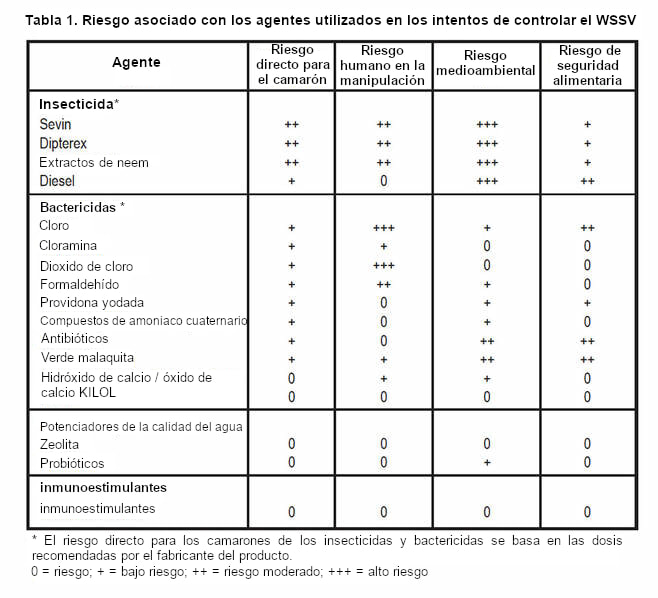
Imagen
To read the full article, Go to: https://www.aquaculturealliance.org/advocate/risks-associated-with-chemicals-and-other-agents-used-in-attempts-to-control-white-spot-syndrome-virus

WSSV-LIKE ORFs AND TRANSPOSABLE ELEMENT-LIKE REPEATS IN THE GENOME OFMarsupenaeus japonicus, Penaeus monodon AND Litopenaeus vannamei 

Shana Singh1*, Michal Plocienniczak2, Laura Hake2, Acacia Alcivar-Warren1-2

1Environmental Genomics, Inc., Southborough, MA 01772 USA; 2Boston College, Chestnut Hill, MA 02467 USA; E-mail: [email protected] 


Imagen
White Spot Syndrome Virus (WSSV) is a double stranded enveloped DNA virus that can produce a persistent infection in the host, causing large economic losses to the shrimp industry.1 The length of WSSV genome is getting shorter and becoming more virulent, but little is known of the evolutionary mechanisms involved in WSSV virulence. Susceptibility of L. vannamei to other viruses like IHHNV and Baculovirus penaei appear genetically determined and related to growth status.2 The petanucleotide TAACC/GGTTA is considered the telomerase sequence of shrimp and a potential site of insertion of transposable elements (TEs) in L. vannamei.3 TEs are known to play a major role on gene regulation, evolution and disease. TEs such as LTR and non-LTR retrotransposons have been identified in P. monodon, M. japonicus, L. vannamei and L. styirostris genomes.3-7 The reverse transcriptase (RTE) gene of unnamed retrotransposon, for instance, was identified as the insertion site of non-infectious IHHNV into the P. monodon genome.4GGTTA repeats flanking the RTE gene, and seven genes homologous to WSSV ORFs, were recently found in a bacterial artificial chromosome (BAC) library clone of M. japonicus.6 We propose that WSSV-like ORFs may relate to WSSV infectivity, latency and/or pathogencity via a TE-mediated mechanism. To begin to understand the potential involvement of TEs in WSSV pathogenicty, more basic information on shrimp TE expression is needed. The goals of this study were to 1) confirm the presence of WSSV-ORFs and TE-like repeats in the M. japonicus BAC clone, and compare it to other penaeids, and 2) classify the TE repeats in the complete WSSV sequences of Thailand, Taiwan and China isolates.

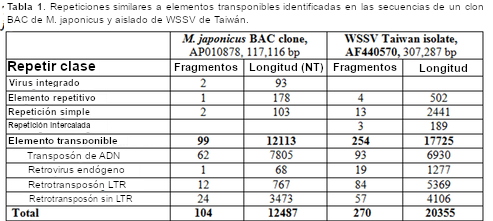
Sequence homology searches using Blastn, Blastx and Blastp databases confirmed the presence of WSSV-ORFs in the M. japonicus BAC clone. Similar WSSV-like ORFs were identified in fosmid clones of P. monodon.5 WSSV-like ORFs were only identified in SPF L. vannamei injected with WSSV, they should be tested again once fosmid- and BAC-end sequences from uninfected L. vannamei are available. Classification of TE repeats using the CENSOR software identified various TE-like repeat classes in M. japonicus genome (Table 1), including the EnSpm DNA transposon (19 fragments totaling 3067 nt) and RTE non-LTR retrotransposon (1 fragment of 876 nt), among others. RTE-like repeats were also identified in DNA and cDNA sequences of P. monodon, L. vannamei, L. stylirostris, M. japonicus, F. chinensis.

The WSSV isolates from Thailand, Taiwan and China also contain repeats that are weakly similar to TE repeats. They include DNA transposons (EnSpm, hAT), endogenous retrovirus (ERV1), LTR retrotransposons (Gypsy, Copia), and non-LTR retrotransposons (LINE-1, R1), among others. However, the RTE non-LTR retrotransposon-like repeats were not found in any of the WSSV sequences from Thailand, Taiwan and China (see Table 1 for a summary of repeats in the Taiwan isolate). Data suggest that different genetic and epigenetic mechanisms are involved in host-DNA virus interactions. More basic epigenetics research is needed to study TE-mediated mechanism(s) involved in WSSV infectivity and/or pathogenicity. 


References
1Sanchez-Paz A 2010. White spot syndrome virus: an overview on an emergent concern. Vet Res 41:43. 
2Alcivar-Warren et al. 1997. Genetic susceptibility of cultured shrimp (Penaeus vannamei) to IHHNV and Baculovirus penaei: Possible relationship with growth status and metabolic gene expression. J Inv Path 70:190. 
3Alcivar-Warren et al. 2006. Isolation and mapping of telomeric pentanucleotide (TAACC)(n) repeats of Penaeus vannamei, using FISH. Mar. Biotech. 8:467.
4Tang & Lightner 2006. IHHNV-related sequences in the genome of the black tiger prawn Penaeus monodon from Africa and Australia. Virus Res. 118:185.
5Huang et al. 2011. Fosmid library end sequencing reveals a rarely known genome structure of marine shrimp Penaeus monodon.BMC Genomics 12:242.
6Koyama et al. 2010. Hyper-expansion of large DNA segments in the genome of kuruma shrimp Marsupenaeus japonicus. BMC Genomics 11:141.
7Hizer et al. 2008. Evidence of multiple retrotransposons in two Litopenaeid species. Anim. Genet. 39(4):363. 


Fuente: https://www.was.org/WASMeetings/Meetings/ShowAbstract.aspx?Id=25601 

YOU WANT TO KNOW MORE...?

Picture
Picture

shell GENETIC DIVERSITY

Picture

MANGROVE BIODIVERSITY IN ECUADOR

Con tecnología de Crea tu propio sitio web con las plantillas personalizables.
  • FUCOBI
    • About us
    • FUCOBI members
    • Gallery
  • Español
  • Awards
  • ONE HEALTH
    • Student Projects
    • mangroveENCODE >
      • DNA methylation and adaptation to salinity stress.
      • Ecuador Mangrove Biodiversity
      • Project on CO2 Absorption by Mangroves
      • Endocrine Disruptive Chemicals (EDCs) in Mangroves
    • ShrimpENCODE >
      • Shrimp Biodiversity and Genetic Diversity
      • TSV in Shrimp
      • WSSV in shrimp
      • Shrimp allergens
      • Metals / Cadmium in Shrimp
      • Biodiversity and Genetic Diversity Fish
      • Shell Genetic Diversity
      • Crab Genetic Diversity
      • Shrimp Epigenome Project
      • Low level endocrine disturbing chemical potentials — changes in the expression of genes causing shrimp allergy in humans and other endocrine disturbing chemicals​
    • childrenENCODE >
      • Project: Foldscopes: From Southborough to Ecuador >
        • Manabí >
          • Portovelo
          • Horconcito&Salinas
        • Pastaza >
          • Arajuno&Shiwakucha
      • Shrimp Scampi
      • We are what we eat
      • Congenital Malformations (Metals and POPs)
      • Cancer and EDCs (metals and POPs)
      • Learn About Pollutants That Affect People
      • Genes that Cause Allergies in Humans
      • Antibiotic Resistance and the Poultry Industry
  • Contact
  • Events
    • Upcoming Events
    • Past Events
    • Scientific expedition
  • publications
  • How can you help
  • Our Blog
  • Portovelo